
Your Custom Text Here
How surfing can empower girls in domestic-violence rife Papua New Guinea

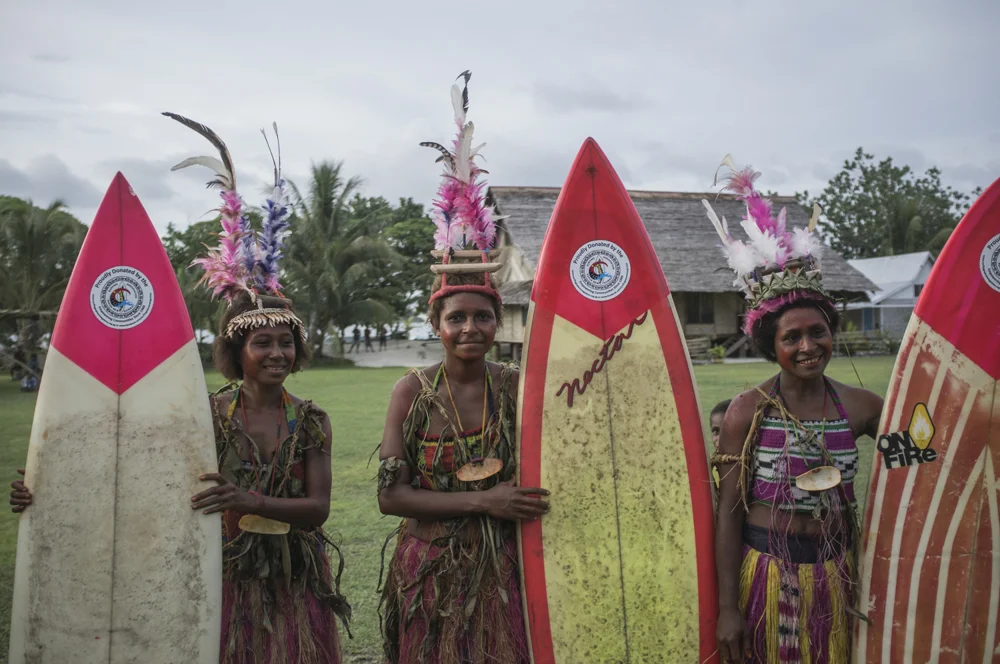
Half of all donated surfboards are painted pink for the girls to have a fair go.
Below me awaits deep, turquoise water. I throw my twinnie in and dive off the edge of a small fishing boat. Jeberdi, the local surf-guide from the fronting village ‘Mereman’ doesn’t waste a heartbeat shredding the three-foot limestone reef lefthander I’m paddling towards.
Like all the locals riding western-style short board ‘thrusters’, Jeberdi proudly surfs atop a second-hand donated board he’s claimed. These donations coming predominately from Australia and Japan have allowed these locals to graduate from their handcrafted wooden ‘splinters’ (chunks of wood) to the modern short board, improving their surfing skills to match the quality of waves on offer that fringe their villages.

Angie and Jeberdi, paddling out for another round.
I gaze toward the hundreds of slender coconut palms that overlook the break and feel eyes on me…through the palms is an entire village of kids and young mothers who have gathered to cheer us on. Inspired, I throw caution aside (I’m a chicken at hollow reef breaks) and paddle for an incoming wave, high-lining along its smooth green wall. Flicking off on the inside next to dry-reef, I look up to the clan of hooting locals. Clapping and cheering my wobbly performance has made their day; their warm response has made mine.

Pure innocence living beach side.
I soon learn why such a simple display can bring joy to these people. In Papua New Guinea’s coastal villages, locals live day-to-day, fishing by hand just enough to feed each other, gathering greens to steam on the side, or visiting the market for fruit and vegetables grown in the highlands. A hunted wild pig is a rare village treat.
Simple huts are constructed from local bush materials and the common machete, and are lived in until the scars of weathering call for a new home (usually built from scratch, next door). Maintenance is a developing concept.
Kids as young as toddlers play in the abundant ocean, sharing ‘splinters’ in the strong surf. Those who can’t get hold of a slab of wood bodysurf naked with giant smiles, running barefoot across the sharp reef, swimming hard against the sweeping currents, and taking off deep. Their smiles are addictive.
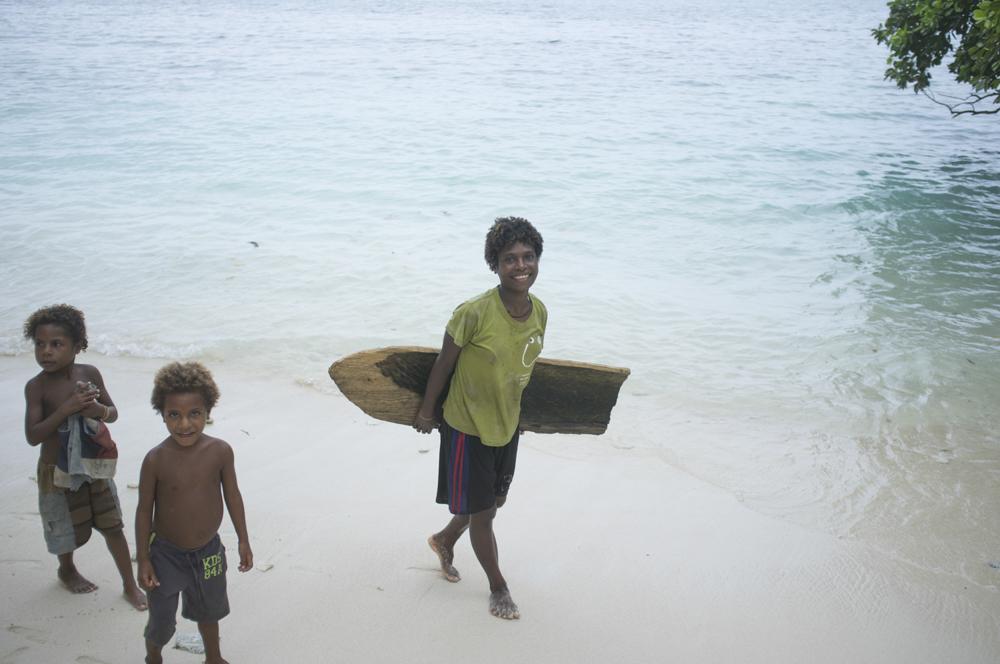
Winifred and her 'splinter'.
I finish up with a small peeler on the inside, then bellyboard a wave into the main bay, some 50 metres down from the crowd. By the time I scramble up the rocky bank, I’ve got a personal welcoming party of 60+ kids, some naked with machetes, laughing, smiling and offering sincere warmth like you’ll never find at any 5-star hotel.
A young girl in a faded lime green tee and knee-length board shorts bends down to offer me her thongs, taking my board under her arms then ushering me upwards toward the masses. Jeberdi informs me later that her name is Winifred, she is about 12 years old (exact age unknown by even her), and is not married nor with child yet because she “surfs too much”. I like her instantly.

Winifred, around 12 years old, who is unmarried and without child because she "surfs too much".
This is a land where mothers are beaten during childbirth by their doctors (to shut up the screams of endurance and pain); are beaten at home by their husbands; and in the world of surfing, are left waiting on the beach until the men are done riding the already-scarce donated boards. It’s not uncommon to birth up to 10 kids, and infant mortality is at one of the world’s highest rates. Surfing is breaking the cycle, and as a result young girls like Winifred might just have the chance to escape the abuse and gender disparity rife throughout PNG.
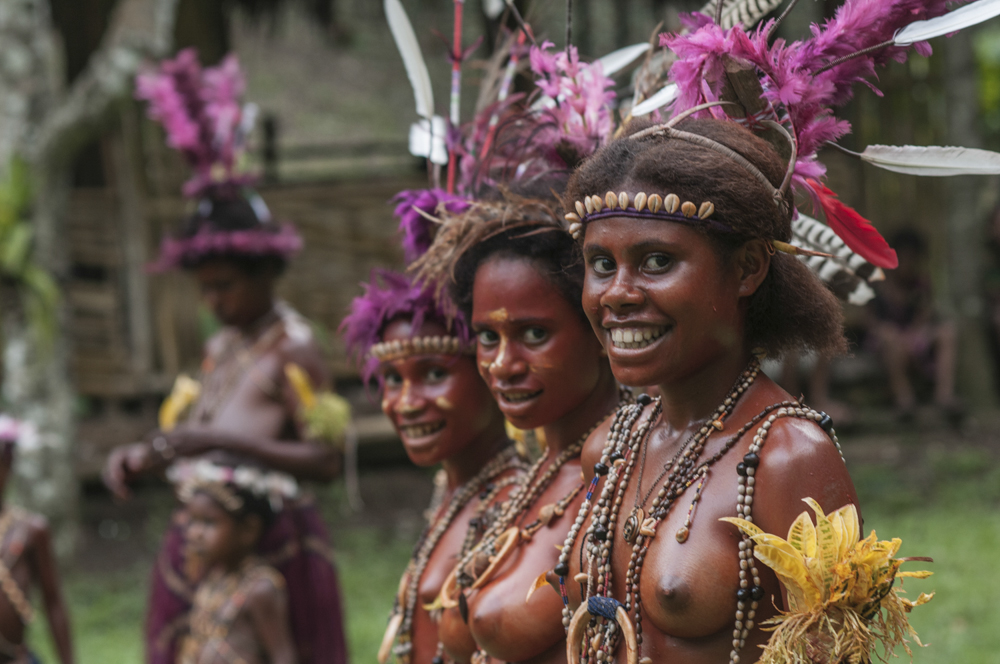
The local women of the Madang Province in traditional handmade dress.
Jeberdi ushers me back toward his village that literally translates to ‘woman man’. The kids run ahead, diving into the bay, taking turns jumping off a jagged rock into the calm water, giggling with a carefree innocence that is forcibly lost in Papua New Guinean adolescence.
Waiting for us on the beach is Justice Nicholas Kirriwon, a Supreme Court Judge and local clan leader from Tupira Surf Club in Ulingan Bay, where I am a guest for the week. ‘Uncle Nick’, as the locals call him, is one of the key influencers driving community development through surf tourism. He drives us back to the coastal grounds of Tupira where we are met with a head-high evening session at the right out front with the other Aussies in our group, Chris Binns, and surf-board donation drive initiator Marty Brown. The quality of surf at Tupira is something of surfers’ folklore: outgoing tide overnight succumbing to an incoming tide all day, ridiculously consistent sets averaging 3ft with forgiving shoulders, the occasional sucky cover-up during tidal pulses, and crowd limits capped at 10 people at any time.

Jeberdi, enjoying his quota out front of Tupira Surf Club.
For most of us fed up with sharing holiday session with the throngs of Aussie punters in the waves off Bali and Fiji, PNG is the proverbial ‘paradise’, attracting out-of-form career mothers like me, and hard working guys like Marty - a fireman from Mornington Peninsula. Marty discovered the northern breaks in early 2000 and has been coming back ever since.
The inspiration for Marty to donate 140-something surfboards to the local surf clubs, the very reason we are all gathered on this trip, came after his first viewing of Adam Pesce’s award-winning documentary ‘Splinters’ at its Australian premiere, where Marty met Andy Abel – President of PNG’sSurfing Association.
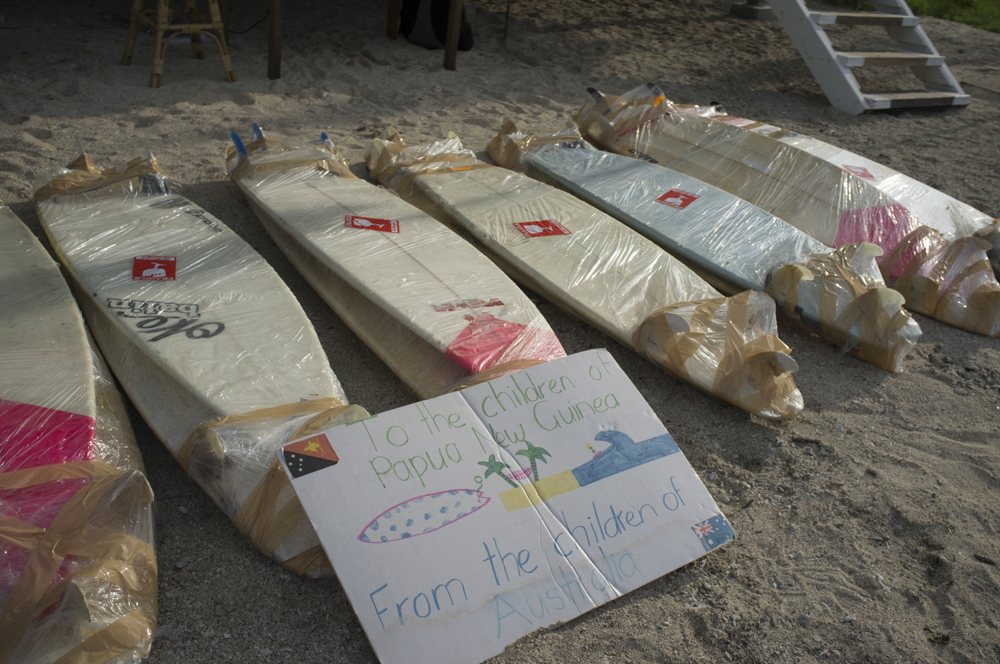
Marty Brown's donation drive.
Abel has been the driving force behind the development of surf culture and tourism in PNG for over twenty years, and what impresses me most is his commitment within the country’s surfing plan to supporting gender equality both in and out of the water, a seemingly impossible goal in an otherwise male-dominated PNG.
In ‘Splinters’, the vile treatment of women by members of PNG’s Vanimo Surf Club was exposed to the world in scenes of brutal domestic violence followed by Abel’s plea to the male surfers of the camp to treat their women with equality. In the film he is also shown asking that the role of Vanimo Club’s Vice President be given to a female. At the international premiere when the scenes sparked outcry, Abel questioned the critics and raised the overlooked truth that domestic violence and inequality of women was rife globally, not just in the surf camps of Papua New Guinea.
To reinforce his efforts of empowering women through surfing, Andy has personally painted half of the donated surfboards’ noses pink, knowing the males will be too embarrassed to ride a female-embossed board. If the males continue as they have in the past to steal the ladies’ boards, Abel has threatened the discontinuation of donations to those village clubs.
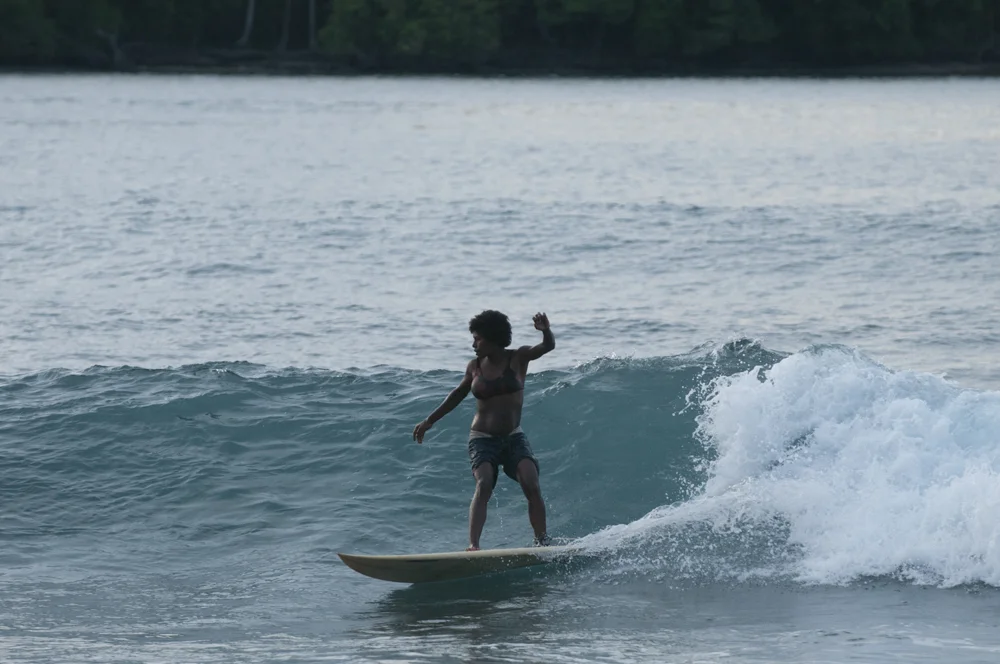
A new mum finishes breast feeding and heads out for a quick wave before dusk on the village's newly donated surfboard.
Our final day is met with a lengthy ceremony on Tupira grounds – once used and abused by the logging industry – addressed by important dignatories and attended by more than 800 local villagers. Marty’s collected boards are finally put in the hands of the locals; half are painted pink and passed to a handful of eager women to share.
A young mother is on the beach with her baby and one of the pink-nosed boards as I am about to paddle out for my final sunset surf. She pulls her newborn off her breast and passes the baby to a friend, before paddling out beside me. Her lopsided breasts are held together in a black crop top, the result of feeding her baby on just one side. In the surf she is fearless and we share waves with our female surfing comrades. When she’s had her fill she paddles in, whipping out the now engorged boob and filling her bubba with more milk. The sky is painted with an evening glow and I have faith that the sun will rise tomorrow with new rays of hope for these lady sliders.

Surviving Hell
By sharing my story, I hope to inspire other women to tap into their inner creativity, their passions and their dreams, and to realise the full potential of their lives.
“It takes 10 times as long to put yourself back together as it does to fall apart. ”
Photo: Getty.
By sharing a snippet of my story, I hope to inspire other women to tap into their inner creativity, their passions and their dreams, and to realise the full potential of their lives.
I couldn’t even recognise the young, broken-faced girl sobbing back at me in public bathroom mirror, at a highway truck stop. The top lid of my left eye protruded so far over the bottom lid that the eyeball below was no longer visible.
Blood was still pouring out of my nose and the pain above the ridge was nothing short of signalling that the bone was in fact broken. Clutching my one-year-old son under my arms, I silently wept in pain and humiliation. Inside my protective womb and under thick layers of winter threads, my 12-week baby slept peacefully.
Just moments earlier, my husband and I had been driving in our car. What led to his sudden rage-filled outburst I may never understand, however the usual triggers were related to stress induced by financial concerns, frustration, nicotine cravings, or jealously – both of the opposite sex or career related.
It was some 15 minutes before a highway exit presented itself, and in those desperately long minutes I had explored all potential opportunities of escape, but sobbing in silence was to be my best chance of surviving without further injury.
Unfortunately, I had become used to my husband’s violent outbursts, having succumbed to his belittlement since three months into our initial romance when he first showed a scary alternate side to his otherwise kind and loving character.
I had several opportunities to walk away from the relationship in the early days, however my love for him, and the bond we had developed as a creative partnership, encouraged me to stay. He was also away often, sometimes for a month or more at a time, flying around the world for his job.
It seemed the absence made the heart grow fonder, and during his stints away I was able to enjoy the independence and freedom I had always cherished. At times he was incredibly inspiring, teaching me much about the media industry and instilling hard work ethics that I still retain to this day, but at other times I was completely terrified of the man I had made my world, as his hideous rage kicked me to the ground, both literally and metaphorically.
By now I was one and a half children in, with a small trickle of income from my work that helped keep our family afloat. And in the midst of the natural disaster, I felt trapped in a prison cell-life that I had chosen independently for myself.
The strong, adventure-seeking, ocean loving girl seemed a world away. Now, all I saw was a lost child desperate to escape, but deep down I knew my husband’s world would be shattered if I did in fact walk away. Instead, I allowed his routine flood of remorse and subsequent apologies sing me back to holding a grain of hope for our family to find happiness in the future.
My husband had lost his mother to cancer, the reason I had not been willing to relocate back to Australia earlier; I felt he needed his wife and son by his side to help him through one of the hardest goodbyes of his life.
The turning point
Back in Oz, our life savings spent re-starting our lives, thanks to the help of friends and family and the universe we landed on our feet and our second son was born naturally in the water, into the arms of very humbled parents. We were living on a friend’s farm in a self-sustainable cabin, grateful for the simplest things like untainted water, fresh produce, and a nuclear-free ocean.
We had no money, but we had each other and for a time the ghost of our violent past seemed behind us. After a few months spent simply bonding amongst nature with our newborn baby, I knew I had to start looking for work as we couldn’t rely on the support of our friends and my family for much longer.
Immigration was taken excruciatingly long to grant my husband’s visa – it ended up taking over a year – and thus I was to become the primary breadwinner of our family.
It didn’t take me long to find an incredible job. I spent two years living the dream with a full-time salary and all the perks: five star hotels and business class flights, and even family trips where my husband and sons could join at no cost.
Gradually, however, I noticed my husband slip into a routine of jealousy-fuelled laziness and then depression, and before long the rage returned. Over the next two years the up and down cycle of physical, verbal and physiological violence continued, until an overseas work trip signalled the end of my patience.
I had since taken a redundancy from my company to begin my own start-up, and was enjoying a modest salary with far more flexibility to spend more time with my family whilst simultaneously accelerating my career.
On the morning I was set to fly out for two weeks, my husband, who had been surprisingly supportive of the upcoming trip (in the past he’d been extremely jealous each time I went away, not replying to emails or allowing me to skype our kids), launched into an unprovoked spectacle announcing I was a terrible mother for leaving my kids among other derogatory comments before dumping my bags on the side of the curb outside our local airport and speeding off without a goodbye.
I was shaking, tears welled in my eyes, and my stomach churned; my body’s now routinely reaction to the emotions that would torture me each time he’d blow up.
As usual, I spent the first week of my trip trying to do my job whilst living in the moment and channelling my inner happiness – after all, I had one of the best jobs in the world that I loved dearly.
At any given moment when wifi was available, I would text apologies and try to justify to the man I’d now been with almost nine years that this was my paid career that I worked hard to earn, and remind him that I had supported him throughout his jet setting career and that I’d appreciate some support in return.
When a text message came through calling me every degrading name under the sun, I laid in my hotel room in a pool of tears for hours, before feeling an overwhelming sense of calm. I’m not sure I realised it at the time, but the stomach-churning feeling had gone.
Breaking the cycle
I had finally, after almost a decade of abuse, switched off the ‘love’ button, and decided instantly that upon return I would ask for divorce.
Watching a shattered man realise his wife was finally serious about leaving was heart breaking. But I knew there was no going back. I had lost the love, and whilst I still felt compassion and sympathy, I knew he would never change if I continued to accept his violent ways.
Similarly, I was very aware that my sons were witness to this unacceptable treatment of women, and as my husband’s father was also physically violent, I stood firmly in my decision to break the cycle of abuse.
My sons would grow up to respect women and not repeat the patterns that humanity has, to the most part, encouraged females to endure.
A year and a half on, I have evolved through intense healing and emotional growth. My tears are now provoked by a sad movie or my sister’s recent walking down the isle, and my injuries are generally surf related.
I have spent countless hours repairing physical ailments caused by the release of emotional trauma trapped within my energy layers with a number of natural professionals.
Despite the struggle of juggling a start-up business and two kids without financial support from my ex, I wake up each day grateful for the opportunities that lie in the present.
As such, my career has moved forward in leaps and bounds as I have rekindled my childhood passions and life dreams.
My friendships and relationships with my family feel transparently real; I no longer have to hide the terrible secrets I kept from them for years.
I joke and sing and dance freely in front of my sons without fear that my personality flaws may put me in hospital.
I work with incredibly inspiring and honest men who have re-instated my trust in the opposite sex, in particular my business partner who I owe so much to; together with his wife and I’ve received incomparable love, support and encouragement both professionally and personally.
Above all, without constantly trying to make my ex-husband happy, and without the eggshells I spent so many years tip-toeing over, I am mostly enjoying the freedom to discover myself again.
On average, more than one woman per week is killed by a current or former partner.
Do you need to speak with someone? Support is available from DV Connect via 1800 811 811 or the website. Alternatively, call 1800 RESPECT on 1800 737 732 or if you’re in danger, call 000.